
Effective retirement income planning is not a static, one-time event; it is a living strategy that must evolve. With recent legislative shifts from SECURE 2.0 updates to 2026 tax code overhauls, adjusting your financial blueprint is critical to avoiding unseen tax traps, maximizing your income, and maintaining lasting peace of mind.
Many individuals approach their golden years with a silent, heavy fear:
What if the rules change and I am no longer prepared?
You have worked hard to build your wealth, but the landscape of retirement today, especially the thing that mostly of retirees dealing with, the retirement income planning part have been constantly shifting beneath retirees feet.
Between sweeping new tax legislation, adjustments to Social Security, and evolving retirement account rules, a strategy that worked flawlessly five years ago may now be leaking money through unnecessary tax burdens or missed retirement income planning opportunities.
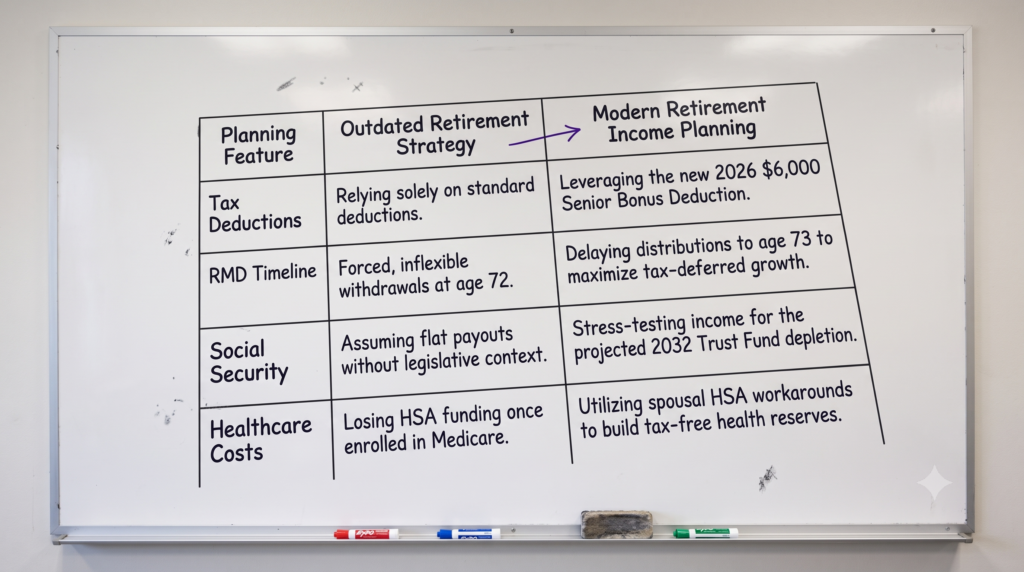
True clarity comes from understanding these shifts and adapting your strategy proactively. To see the difference between a stagnant strategy and a dynamic one, consider this blueprint:
Navigating the 2026 Tax Landscape
The tax environment has fundamentally changed following the recent passage of the “One Big Beautiful Bill” (OBBBA), meaning your tax planning must change with it. This legislation extended reduced tax brackets and slightly increased the standard deduction for 2025, which is now $32,200 for married couples filing jointly.
However, the most critical insider opportunity for retirees is the introduction of a new $6,000 “Senior Bonus Deduction” per person for taxpayers aged 65 and older. This bonus deduction is uniquely powerful because it is available from 2025 through 2028 and can be applied whether you take the standard deduction or choose to itemize.
You must pay close attention to your Modified Adjusted Gross Income (MAGI). This new bonus deduction begins to phase out at $150,000 of MAGI for joint filers and $75,000 for single filers.
If your retirement income planning involves large IRA withdrawals or Roth conversions, you must carefully manage your income thresholds so you do not accidentally disqualify yourself from this valuable tax break.
Adapting to SECURE Act 2.0 Opportunities
If you have not updated your distribution strategy recently, you may be missing out on vital benefits introduced by the SECURE Act 2.0. The legislation provided a massive sigh of relief for retirees by delaying the start of Required Minimum Distributions (RMDs) to age 73.
This extra time allows your investments to grow tax-deferred for longer, providing a larger buffer against inflation. Additionally, if you are still working and aggressively saving, the catch-up contribution limits for individuals aged 50 and older have been increased to $10,000.
However, the law stipulates that these catch-up contributions must be made as Roth IRA contributions, meaning they are funded with after-tax dollars.
The Reality of Social Security’s Financial Future
Headlines frequently claim that Social Security is “going broke,” which causes immense anxiety for those relying on it. The truth is more nuanced, and your retirement income planning must account for the actual data.
According to the latest Trustees Report, the Old-Age and Survivors Insurance (OASI) Trust Fund has sufficient reserves to pay 100 percent of scheduled benefits until 2032. If Congress fails to enact legislative changes by then, continuing payroll taxes would still be sufficient to pay approximately 78 percent of scheduled benefits.
Social Security is not disappearing, but future benefits may be reduced, meaning your personal investments and pensions must be properly positioned to fill any potential gaps.
Furthermore, if you are a retired federal worker covered by the Civil Service Retirement System (CSRS), the recent Social Security Fairness Act has repealed the Windfall Elimination Provision (WEP) and the Government Pension Offset (GPO).
This historic change allows many civil servants to finally receive larger, unpenalized Social Security benefits, completely altering their long-term income projections.
Navigating Medicare and HSAs
Healthcare is often the most unpredictable expense in retirement that could cost a huge blow if your having such problems that connects deeply in your retirement income planning road.
Many pre-retirees heavily utilize Health Savings Accounts (HSAs) due to their triple-tax advantage. However, a silent trap affects many seniors: once an individual enrolls in Medicare, they are strictly prohibited from funding an HSA, even if they are still working.
There is a highly effective workaround. If you are on Medicare but have a working spouse who is not yet eligible for Medicare and is covered by a high-deductible health plan (HDHP), they are still eligible to make a full family contribution ($8,750 in 2026) to an HSA in their name only.
This allows your household to continue building tax-free healthcare reserves while you safely utilize your Medicare benefits.
Frequently Asked Questions (FAQ)
1. When do I legally have to start taking withdrawals from my retirement accounts?
Under the SECURE Act 2.0, the age to begin Required Minimum Distributions (RMDs) has been extended to age 73. This gives your assets more time to grow tax-deferred before you are forced to take taxable withdrawals.
2. How do I qualify for the new $6,000 Senior Bonus Deduction?
To qualify, you must be 65 or older by the last day of the tax year. However, the deduction phases out if your Modified Adjusted Gross Income (MAGI) exceeds $150,000 for married couples filing jointly, or $75,000 for single filers.
3. Will Social Security completely run out of money in the next decade?
No. While the OASI Trust Fund reserves are projected to be depleted by 2032, the program will continue to collect payroll taxes. Even if Congress takes no action, incoming revenue would still cover approximately 78% of scheduled benefit payouts after 2032.
4. Can I still contribute to my Health Savings Account (HSA) once I go on Medicare?
No, once you enroll in Medicare, you can no longer contribute to an HSA. However, if your younger spouse is not yet on Medicare and has a high-deductible health plan, they can still make family contributions to an HSA in their own name.
5. How did recent laws change Social Security for federal CSRS retirees?
The Social Security Fairness Act repealed both the Windfall Elimination Provision (WEP) and the Government Pension Offset (GPO). This allows CSRS retirees, who previously saw their Social Security benefits reduced due to their federal pensions, to receive larger, unpenalized payouts.

This article is not to be construed as financial advice. It is provided for informational purposes only and it should not be relied upon. It is recommended that you check with your financial advisor, tax professional and legal professionals when making any investment decisions, or any changes to your retirement or estate plans. Your investments, insurance and savings vehicles should match your risk tolerance and be suitable as well as what’s best for your personal financial situation.
Sources:
- https://www.ssa.gov/oact/solvency/index.html
- https://www.definefinancial.com/blog/one-big-beautiful-bill-retirement-planning/
- https://www.govexec.com/pay-benefits/2026/03/how-federal-retirement-benefits-have-changed-over-years/412244/
- https://crr.bc.edu/new-tax-break-for-seniors/
- https://www.dol.gov/general/topic/retirement/typesofplans
- https://www.actsretirement.org/resources-advice/finance-saving-money/new-rules-7-changes-to-retirement-planning/
- https://www.myfederalretirement.com/social-security-future-federal/
- https://pensionrights.org/issue/changes-to-retirement-plans/
- https://www.irs.gov/newsroom/2026-filing-season-updates-and-resources-for-seniors
Ideas by Mike Podcast™
All Episodes